
Recent POST


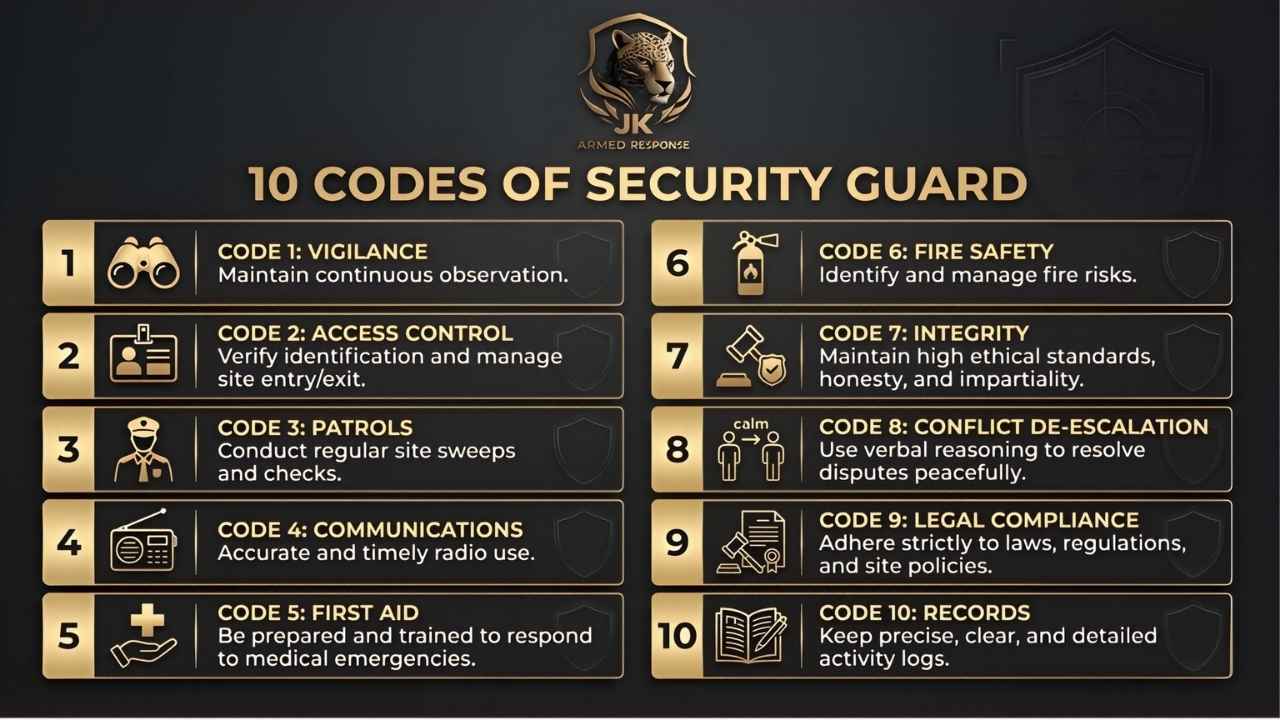
The “10 codes of security guard” are a standardized system of numerical words used by security professionals to communicate over two-way radios. Instead of using long sentences, a guard transmits a simple number combination. The most critical codes are 10-4 (Message received), 10-7 (Out of service), 10-8 (In service), and 10-20 (Current location).
The primary problem these codes solve is radio channel congestion during critical moments. When an incident occurs, multiple units often need the radio simultaneously. Plain English takes too long to speak and is easily misunderstood over static. Using a designated code compresses a 15-second panicked update into a clear, two-second transmission.
Industry data shows 10 codes of security guard that using standardized brevity codes reduces radio transmission time by up to 60%. This efficiency is exactly why our tactical units and control room operators at JK Armed Response use this system daily across Johannesburg. It ensures rapid, coordinated deployments without tying up essential communication lines.
So, why does plain speech fail so often during a live security incident? Let’s break down the tactical advantages of this system.
The Tactical Advantage of Using Standardized Codes
Criminal syndicates frequently use commercially available scanners to monitor local radio frequencies. If a guard broadcasts their exact movements in plain English, criminals can easily anticipate their arrival. Standardized codes mask the nature of the conversation. This keeps operational secrecy intact while a response unit is en route.
Channel congestion is another major operational hazard. Only one person can broadcast on a two-way radio at a time. If a guard takes 30 seconds to explain a situation, no one else can call for help. The Ten-code system solves this by enforcing absolute brevity.
Finally, adrenaline severely impacts human speech. During an armed robbery or home invasion, a guard’s heart rate spikes. Panicked speech can make “we are leaving” sound like “we are bleeding” over a crackling radio. Numerical codes remove emotion from the equation, preventing dangerous misunderstandings.
Knowing why we use them is just the first step. Next, we will look at the exact codes every professional security officer must memorize.
The Core 10 Codes for Armed Response & Patrols
Most generic lists provide a hundred different codes, many of which are never used in private security. To be highly effective on the ground, guards should focus on these tactically grouped codes.
1. Routine Status & Movement These are the everyday codes used to track officer locations and shift changes.
- 10-4: Message received and understood. This simply acknowledges an order.
- 10-7: Out of service. A guard uses this when stepping down from a vehicle or taking a break.
- 10-8: In service. This tells the control room the unit is active and ready for dispatch.
- 10-20: What is your location? Alternatively, it is used to state a location (e.g., “My 10-20 is Dragon City”).
2. Emergency & Tactical Escalation These codes clear the radio channel and immediately signal high-priority threats.
- 10-10: Fight in progress. Used for physical altercations not involving firearms.
- 10-31: Crime in progress. This requires an immediate tactical response.
- 10-32: Person with a firearm. This alters the entire approach of the responding backup units.
- 10-33: Emergency – All units stand by. This command strictly clears the channel for priority traffic only.
- 10-78: Need immediate assistance. This is the highest priority call, signaling an officer is in direct trouble.
3. Observation & Reporting These codes are used to report anomalies before they escalate into active crimes.
- 10-14: Prowler or suspicious person reported on the premises.
- 10-37: Suspicious vehicle. Often used when a car is idling near a client’s property.
- 10-50: Traffic accident. Guards frequently use this to secure an area before paramedics arrive.
Understanding the codes is important, but applying them in the field requires practice. Let’s look at how this plays out during a real shift.
Real-World Application: A Tactical Scenario
Consider a night patrol unit 10 codes of security guard conducting routine checks near a commercial client’s premises in Fordsburg. The guard spots a panel van idling with its lights off near the perimeter fence. Plain English would be slow and alert anyone listening.
Instead, the communication is fast and precise.
- Guard to Control: “Control, this is Unit 3. I have a 10-37 at the main gate. Requesting a 10-28 on a white van.” (10-28 is a vehicle registration check).
- Control to Guard: “10-4, Unit 3. Stand by.”
- Guard to Control (Situation escalates): “Control, 10-31. Suspects attempting entry with bolt cutters. 10-78!”
In under ten seconds, the control room knows exactly what is happening, where it is happening, and that immediate armed backup is required. There is no confusion and no wasted time.
To execute this properly, guards must also follow strict radio rules.
Radio Etiquette & Best Practices for Security Teams
Knowing the numbers means nothing if the execution is poor. Professional tactical communication relies on three fundamental rules.
First, think before you key the radio. You must mentally prepare the specific code and your exact location before pressing the Push-To-Talk (PTT) button. Stuttering or hesitating wastes valuable airtime.
Second, utilize the “One-Second Rule.” Press the button, wait one full second, and then begin speaking. Radios have a slight transmission delay. If you speak immediately, the first number of your code will be cut off, causing the control room to ask for a repeat.
Third, keep all emotion off the air. You must maintain a flat, professional tone regardless of the threat level. The code itself dictates the urgency of the situation. A calm, clear “10-33” is far more effective than screaming for help into the microphone.
Final Thoughts on Tactical Communication
Mastering the 10 codes is a non-negotiable requirement for serious security operations. It removes the guesswork from emergency dispatch and ensures that backup arrives precisely when and where it is needed. Professional communication directly translates to better protection.
At JK Armed Response, our officers undergo rigorous training in tactical radio communication. We do not leave room for error when protecting our clients. If you need highly trained, highly responsive security guarding or VIP protection, visit jkarmedresponse.co.za to secure your premises today.
10 Codes of Security Guard to Improve Operations
The “10 codes of security guard” are a standardized system of numerical words used by security professionals to communicate over two-way radios. Instead of using long sentences, a guard transmits a simple number combination. The most critical codes are 10-4 (Message received), 10-7 (Out of service), 10-8 (In service), and 10-20 (Current location). The primary […]

One thought on “10 Codes of Security Guard to Improve Operations”