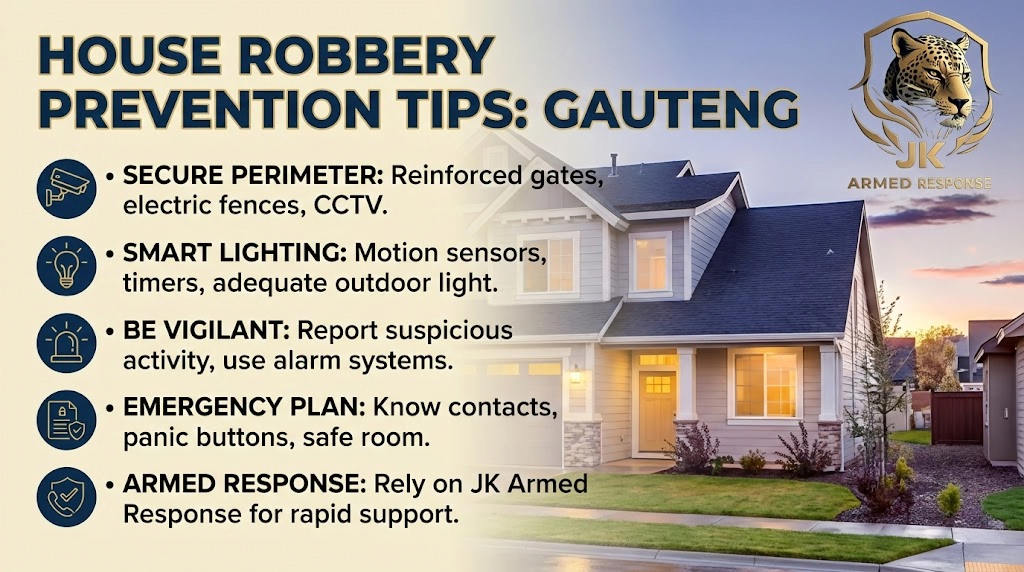
Crime in Gauteng has changed. Your security strategy needs to change with it.
Most homeowners in Gauteng rely on what we call “passive security.” You have high walls, electric fences, and an alarm system linked to a control room. In theory, this should be enough. In reality, the 2025/2026 crime statistics tell a different story.
Criminals have adapted to our defensive measures. They know exactly how long a lead-acid battery lasts during Stage 4 load shedding. They know that a national call center in Cape Town takes precious minutes to dispatch a vehicle to a driveway in Johannesburg.
True prevention isn’t just about the height of your wall; it is about the speed of the reaction when that wall is breached.
This guide moves beyond the generic advice you’ve heard a thousand times. We are stripping away the fluff to focus on the critical failure points in Gauteng home security systems—and exactly how JK Armed Response solves them.
The “Load Shedding” Gap: Is Your Security System Actually On?
Here is the most dangerous misconception in South African home security: assuming your alarm works just because the keypad light is on.
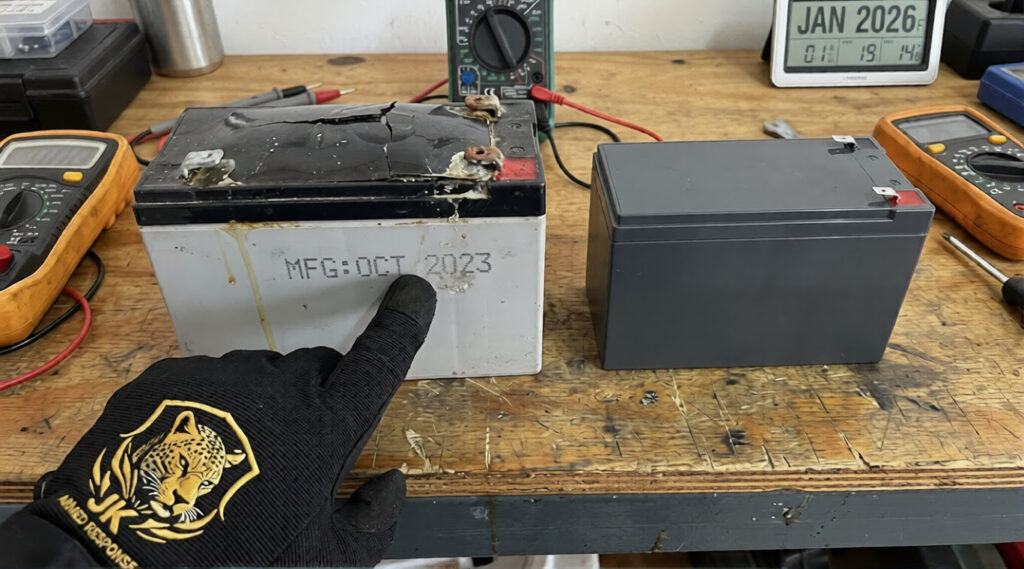
During persistent load shedding (Stage 4 and above), standard alarm batteries face a critical failure point. Most security systems come installed with standard lead-acid batteries. These are designed for occasional power outages, not daily blackouts.
The Failure Cycle: A lead-acid battery has a lifespan of roughly 200–300 discharge cycles. If we have load shedding twice a day, you burn through that lifespan in less than six months. Once the battery degrades, your alarm might trigger a “low battery” signal, or worse, it might simply die three hours into a four-hour power cut.
If your radio transmitter loses power, your panic button is nothing more than a plastic toy. You can press it, but no signal reaches the control room.
The JK Armed Response Solution: We don’t wait for your battery to die. We advocate for and install Lithium Iron Phosphate (LiFePO4) backups.
Longevity: Lithium batteries handle over 2,000 discharge cycles.
Reliability: They maintain a steady voltage until the very end, ensuring your radio signal punches through to our control room every single time.
Proactive Monitoring: Our control room receives “mains fail” and “low battery” signals. If we see your system struggling, we call you before you are left vulnerable.
Don’t guess your battery health. If your alarm keypad beeps during load shedding, your system is already compromised.
The Driveway “Kill Zone”: Preventing Access Gate Hijackings
Statistics from 2025 indicate that the driveway remains the highest-risk zone for robbery initiation in Gauteng. Roughly 70% of house robberies begin not with a break-in, but with a “follow-home” or driveway ambush.
The danger moment is static time—the seconds you spend waiting for your gate to open.
The “Stay in the Vehicle” Rule: Many residents still manually open gates during power outages or get out to move bins. This is a critical error. You effectively surrender your mobile advantage (your car) and your physical barrier.
The JK Service Advantage: We focus on reducing your static time and increasing visibility.
High-Speed Gate Motors: We recommend motors that open and close in under 10 seconds.
Battery Backup for Gates: Just like your alarm, your gate motor needs a high-cycle lithium backup. A manual gate is a trap during a blackout.
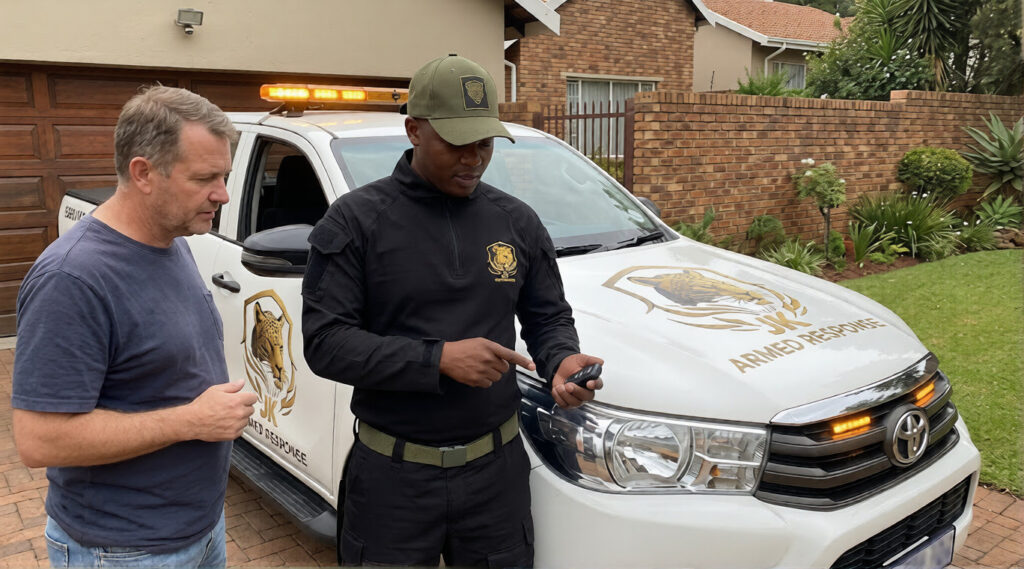
Meet-and-Greet Services: If you feel unsafe arriving home late at night, JK Armed Response offers a meet-and-greet service. Call our control room, and an armed response officer will wait at your gate to ensure you enter safely. This simple service removes the risk entirely.
The “National Call Center” Flaw: Why Local Dispatch Wins
When you press your panic button, where does the signal go?
For many large national security companies, that signal is routed to a massive call center in a different province, often Cape Town or Durban. That operator then has to electronically dispatch a vehicle that might be sectors away. This relay game adds 5 to 10 minutes to the response time.
In a house robbery, 5 minutes is an eternity.
The JK Localized Difference: At JK Armed Response, we operate on a decentralized, localized grid.
Direct Comms: Your signal hits our local Gauteng control room.
Tactical Dispatch: Our controllers speak directly to the vehicles in your specific suburb. There is no middleman.
The Sub-7 Minute Goal: Because our vehicles patrol specific, smaller grids rather than massive zones, our average reaction time is significantly faster than the national average.
We aren’t trying to cover the whole country. We are trying to protect your street.
Audible vs. Silent Panic: Knowing When to Use Which
Panic buttons are standard, but very few homeowners are trained on how to use them effectively during a high-stress event. Using the wrong type of panic can escalate a situation.
Scenario A: The Prowler (Pre-Entry) If you hear someone in the garden or tampering with a window, use the Audible Panic.
Goal: Scaring them away.
Effect: Sirens blare, lights flash. Most opportunistic thieves will flee immediately.
Scenario B: The Home Invasion (Post-Entry) If the intruders are already inside your home, you must switch to Silent Panic.
Goal: Summoning help without tipping off the attackers.
Effect: The siren stays off. The intruders remain calm(er), thinking they are in control.
Our technicians don’t just install buttons; we explain this “Audible vs. Silent” logic to every family member, ensuring everyone knows the strategy.
Perimeter Breaches: Early Warning is Critical
If your alarm only goes off when the front door opens, you have lost the tactical advantage. You want to know they are there when they are at the wall, not at the bedside.
The Problem with Beams: Homeowners often disable outdoor beams because of false alarms caused by pets or plants. A disabled beam is a welcome mat for criminals.
The JK Solution: We install dual-technology outdoor beams and smart analytics cameras.
Pet Immunity: Modern sensors can distinguish between a 40kg German Shepherd and a crawling human.
Video Verification: When a beam trips, our control room can immediately access the linked CCTV feed. We verify if it’s a threat or a Hadeda ibis.
Instant Dispatch: If we see a human, we dispatch immediately—often before the intruder has even touched the house.
Conclusion: Don’t Wait for the Victim Stats
A high wall buys you time. A localized, armed response team buys you safety.
The difference between a “burglary attempt” and a “house robbery statistic” is often the speed of the response. At JK Armed Response, we combine technical resilience (lithium power) with tactical speed (local dispatch) to ensure that when you press that button, help arrives fast.
Don’t wait until the power goes out to discover your battery is dead.
Next Step: Is your alarm system load-shedding proof? Contact JK Armed Response here for a Free Battery Health Check and security assessment today. Let’s make sure your safety isn’t reliant on the grid.
House Robbery Prevention Tips Gauteng: Load Shedding
Crime in Gauteng has changed. Your security strategy needs to change with it. Most homeowners in Gauteng rely on what we call “passive security.” You have high walls, electric fences, and an alarm system linked to a control room. In theory, this should be enough. In reality, the 2025/2026 crime statistics tell a different story. […]





One thought on “House Robbery Prevention Tips Gauteng: Load Shedding”