
Recent POST




It is 2:00 AM. The neighborhood goes dark as Stage 4 load shedding kicks in. Your alarm keypad beeps once, signaling the switch to battery power. You roll over, assuming you are safe.
But you aren’t.
By 4:00 AM, two hours into the blackout, your alarm system is dead. The “Armed” light on your keypad has flickered off. Your perimeter beams are down. Your panic button is just a piece of plastic. You are sleeping in a house with zero electronic defense, and criminals know it.
This is the “Dead Zone.” It is the specific window of vulnerability that syndicates in South Africa are exploiting with increasing precision.
At JK Armed Response, we don’t just sell alarms; we engineer systems that survive the grid collapse. This guide explains exactly why standard security setups fail during frequent power cuts and how our specialized protocols keep your home secure when the lights go out.
The Technical Problem: Why Your Battery Is Dying
Most South African homes are protected by standard 7Ah lead-acid batteries. Under normal conditions, these work perfectly. But Stage 4 load shedding is not “normal.”
The “Death Spiral” of Lead-Acid
The chemistry of a standard lead-acid battery is not designed for the South African power crisis.
- Recharge Time: A standard lead-acid battery requires roughly 24 to 48 hours to recharge fully after a deep discharge.
- The Reality: During Stage 4 or 6, you only have electricity for 6 to 8 hours between outages.
This creates a deficit. Every time the power comes back on, your battery only charges to 60%. Then 40%. Then 20%. Eventually, the battery voltage drops so low that your alarm panel creates a “Low Battery” false alarm, screaming at 3 AM until you physically disconnect it to silence the noise.
Once you disconnect it, you have no security.
According to insurance data, burglaries increase by 3.2% during the week and over 8% on weekends when load shedding intensifies. This isn’t a coincidence; it is a calculation by criminals who watch for the dark houses with silent alarms.
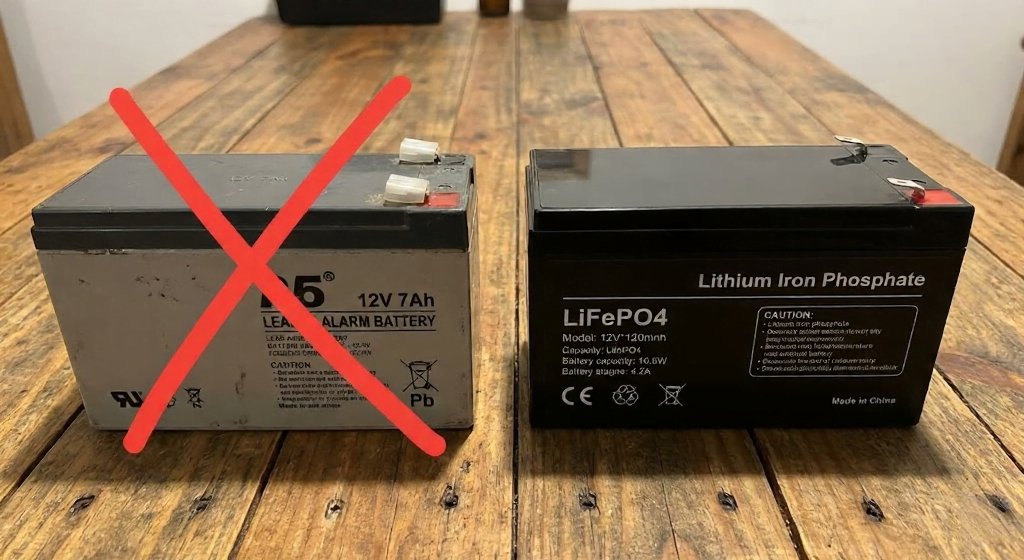
The Hardware Solution: Upgrading Your Defense
You cannot rely on the battery that came with your alarm system five years ago. To survive Stage 6, you need to upgrade the physics of your energy storage.
1. The Lithium Advantage
We transition our clients to Lithium Iron Phosphate (LiFePO4) batteries. Unlike lead-acid, these batteries are designed for the abuse of load shedding.
- Fast Charging: They charge up to 5 times faster than lead-acid units. A 4-hour power window is enough to get them back to full capacity.
- Deep Discharge: You can use 90% of the battery’s capacity without damaging it. Standard batteries fail if you use more than 50%.
- Lifespan: A lead-acid battery dies in 6–12 months under Stage 4 stress. A Lithium iron phosphate battery lasts for thousands of cycles, often outliving the alarm panel itself.
2. The Communication Gap
Your alarm system likely communicates via a telephone line or your home Wi-Fi. The problem: When the power cuts, your Wi-Fi router turns off. Your alarm might still be on, but it can’t tell anyone if a window is broken. It is screaming into a void.
The Solution: We install independent GPRS/GSM radio modules. These devices use mobile networks to send signals directly to the JK Armed Response control room. They have their own power supply and do not rely on your home internet. If your phone has signal, our control room gets the alarm.
The Service Solution: When Hardware Isn’t Enough
Even the best technology has limits. A battery can be drained, and a signal can be jammed. This is where the human element of security becomes non-negotiable. Technology monitors; people protect.
Smart Zoning and “AC-Fail” Monitoring
Our control room doesn’t just wait for a burglary signal. We monitor for “AC-Fail” signals—the specific code your alarm sends when mains power is cut.
When we receive an AC-Fail signal from your home:
- We log the time of the outage.
- We cross-reference it with the load shedding schedule.
- If the signal doesn’t restore when the grid returns, we know your system is compromised or your battery is dead, and we contact you immediately.
Load Shedding Patrols
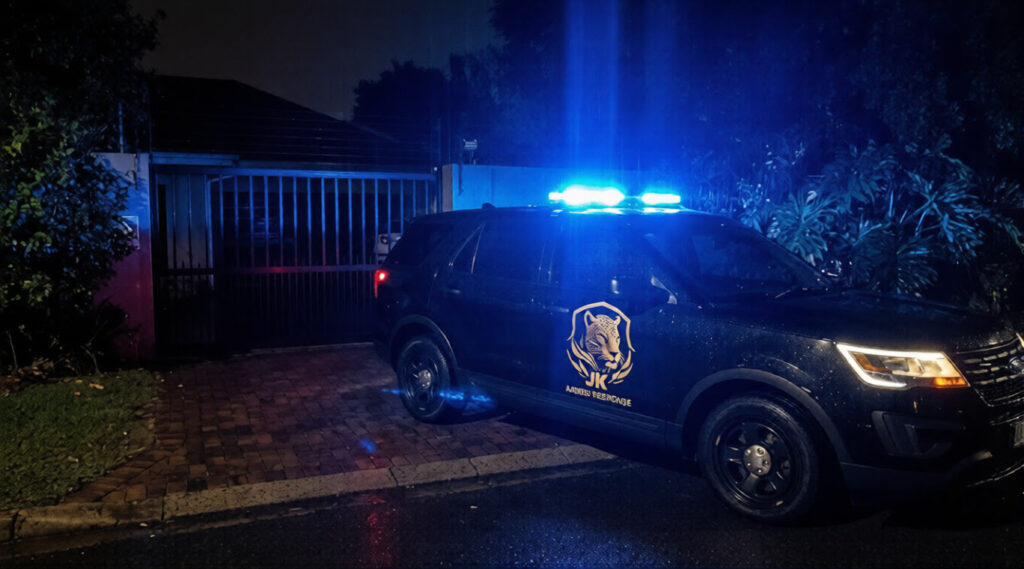
Criminals rely on the cover of darkness. We counter this with high-visibility presence. During confirmed blackout windows, JK Armed Response re-routes patrol vehicles to affected zones.
Our vehicles patrol with blue lights flashing. This serves two purposes:
- Deterrence: It signals to spotters that despite the darkness, the area is active and watched.
- Visual Checks: Our officers physically inspect gate lines and perimeters that might be vulnerable due to non-functioning electric fences.
Critical Vulnerability: The Gate and The Fence
Your house alarm is your last line of defense. Your perimeter is your first. Load shedding compromises the perimeter first.
The Electric Fence Energizer
An electric fence is just a psychological barrier. Without power, it is simply a ladder made of wire. Most energizers have backup batteries, but they are often neglected. If your fence voltage drops, the alarm won’t trigger when the wires are cut. We recommend dedicated lithium backups specifically for energizers to ensure the “shock” remains active for the full duration of a 4-hour outage.
The “Meet and Greet” Necessity
The most dangerous moment during load shedding is arriving home.
- Your street lights are out.
- Your neighbors’ lights are out.
- Your electric gate moves slower on battery power (or must be opened manually).
This creates a prime window for hijacking.
JK Armed Response offers a “Meet and Greet” service. If you are arriving home during a blackout and feel unsafe, call our control room. An armed response officer will meet you at your gate, survey the immediate area, and wait until you are safely inside and your perimeter is locked. This service bridges the gap where technology fails.
JK Armed Response: The “Always On” Guarantee
You might wonder, “If my power is out, is the security company online?”
Yes. We practice what we preach. The JK Armed Response infrastructure is built on redundancy. Our control room, communication towers, and server rooms are backed by industrial-grade solar and generator systems. We do not go offline. When the city grid fails, our internal grid takes over instantly.
Technical Health Assessment
Don’t wait for a break-in to discover your battery is dead.
We offer a Load Shedding Health Check. Our technicians will:
- Test the load capacity of your current batteries.
- Check the signal strength of your radio transmitter during outages.
- Verify that your panic buttons are active even when the keypad display is off.
Conclusion
Security is not a “set and forget” product in South Africa anymore. It is an active battle against infrastructure failure. You cannot stop Eskom from cutting the power, but you can stop criminals from using that darkness against you.
Your safety requires a system that adapts to the grid. It requires Lithium technology, independent communication, and a response team that is awake when the rest of the suburb is asleep.
Is your home secure for the next Stage 6?
Do not gamble with the “Dead Zone.” Contact JK Armed Response today. Let us assess your backup power systems and ensure that when the lights go out, your protection stays on.
[Get Your Free Backup Security Assessment Here]
Best Security Systems for Load Shedding South Africa 2026
It is 2:00 AM. The neighborhood goes dark as Stage 4 load shedding kicks in. Your alarm keypad beeps once, signaling the switch to battery power. You roll over, assuming you are safe. But you aren’t. By 4:00 AM, two hours into the blackout, your alarm system is dead. The “Armed” light on your keypad […]

One thought on “Best Security Systems for Load Shedding South Africa 2026”