
Recent POST



Why Solar Panel Theft is Rising in South Africa
South Africa is currently facing a unique crime wave targeting energy infrastructure. Recent crime statistics indicate a sharp increase in the theft of solar panels and backup batteries, directly correlated with the intensity solar panel protection systems of load shedding.
Criminal syndicates view photovoltaic (PV) systems as low-risk, high-reward targets. Unlike cash or jewelry hidden inside a locked home, installers often mount solar panels on the roof, completely outside the building’s primary security perimeter.
Thieves are not acting randomly. Highly organized groups often scout neighborhoods during the day to identify homes with visible installations. They strike when the power grid fails, assuming the outage has disabled security systems and perimeter beams or forced them to run on low battery reserves.
The reality for homeowners in Gauteng and across the country is that a standard home alarm is no longer sufficient. To protect an investment that costs tens of thousands of Rands, you need a specialized Solar Panel Protection System. This requires shifting your mindset from simple “theft prevention” to a robust, three-layered defense strategy.
Layer 1: Physical Deterrence (The First Line of Defense)
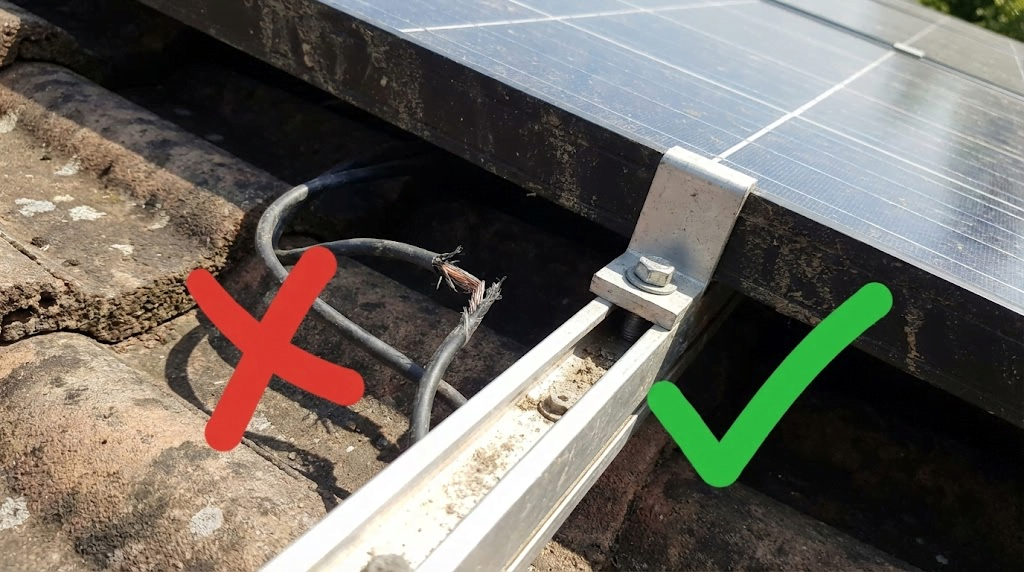
The first step in securing your solar array is making the physical act of theft difficult and time-consuming. Most standard solar installations use simple aluminum clips that can be unscrewed with a standard Allen key in seconds.
Anti-Theft Mounting Clips replaced these standard fasteners with tamper-proof mechanisms.Standard tools found at a hardware store cannot remove these specialized clips, which often use shear nuts or require unique ‘coded’ keys.
Stainless Steel Locking Bars offer a more visible deterrent. These bars run across the frame of the panels and are padlocked or bolted to the mounting rail. They physically prevent the panel from being lifted off the roof, even if the clamps are loosened.
Cable Locking Systems involve threading a high-tensile steel cable through the frames of the panels. This binds the entire array together, meaning a thief would need to cut through a thick steel cable while balanced precariously on a roof.
However, physical barriers have a limitation. They are “passive” defenses. Given enough time and a battery-operated angle grinder, a determined syndicate can bypass them. Their primary function is to buy time—turning a 5-minute quiet job into a 20-minute noisy ordeal. This delay is crucial for the effectiveness of the next layer.
Layer 2: Electronic Detection (The “Early Warning” System)
Physical locks delay the thief, but electronic detection alerts you before the theft is complete. This layer integrates your solar array directly into your existing home security system, treating the roof as a distinct “zone.”
Vibration Sensors are small devices attached to the solar panels or the metal racking underneath. They are calibrated to detect the specific frequency of impact—such as a hammer striking a bolt or a wrench leveraging a frame.
Unlike standard motion sensors which might be triggered by birds or heavy rain, high-quality vibration sensors are designed to minimize false alarms while detecting aggressive tampering.
The “Loop” System is perhaps the most reliable method for electronic detection. This involves running a fiber optic cable or a wired loop through the frame of the panels.
This loop creates a closed electrical circuit connected to a 24-hour zone on your alarm panel. If a thief cuts the wire to remove a panel, or pulls the panel hard enough to break the connection, the circuit opens, and the alarm trips instantly.
AI Perimeter Beams provide a final layer of electronic safety. By mounting outdoor beams (like Optex or Takex sensors) at gutter level or on the roofline, you can detect movement before the criminal even touches the panels.
Modern beams use Passive infrared sensors combined with microwave technology to distinguish between a human intruder and environmental noise like shifting shadows or stray cats.
Layer 3: The Missing Link – Armed Response & Monitoring
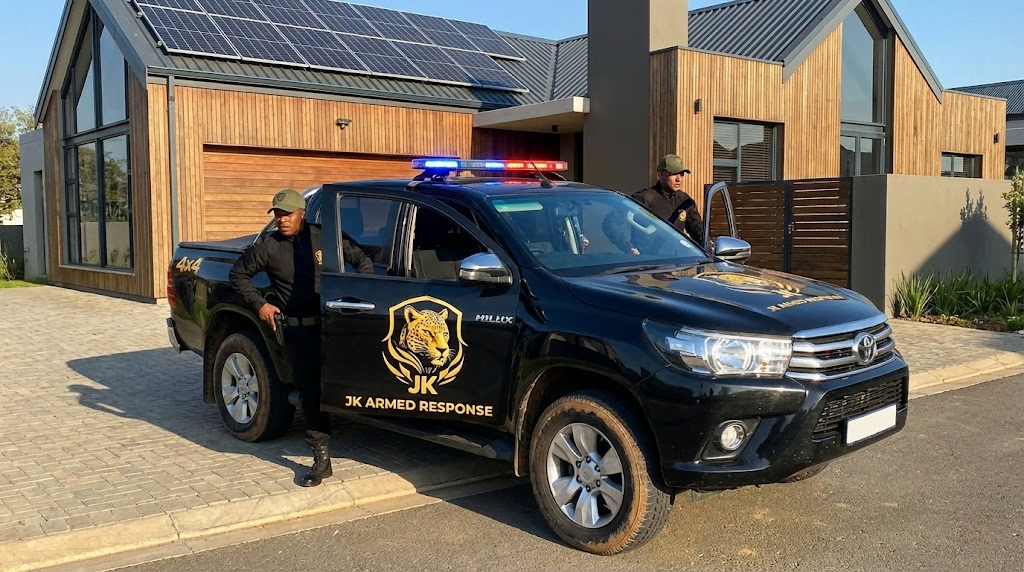
The first two layers are designed to detect and delay. But a siren wailing on a roof is effectively useless if no one responds to it. This is where JK Armed Response becomes the critical final component of your protection system.
Criminals are brazen. They know that in many neighborhoods, neighbors ignore alarms, assuming they are false triggers. They also know that private security companies often prioritize “panic button” calls over general alarm activations.
At JK Armed Response, we treat solar zone activations as high-priority dispatch events. We understand that a roof alarm is rarely a false positive; it almost always indicates a perimeter breach.
The “AC-Fail” Protocol We utilize smart monitoring to track mains power status. If we receive a “Mains Fail” signal from your property (indicating load shedding or cable theft) followed immediately by a loss of signal from your perimeter beams, our control room operators recognize this pattern as a targeted attack.
Visual Verification By linking your CCTV system to our control room, we can visually verify a roof incursion. This allows us to dispatch our armed response vehicles with precise information about the number of intruders and their location on your property.
Choosing the Right Protection System for Your Property
The scale of your protection should match the scale of your installation.
For Residential Properties: Homeowners usually require a mix of tamper-proof clips and a wired loop system connected to the house alarm. This is cost-effective and integrates seamlessly with standard residential alarm panels like Paradox or IDS. The goal is to ensure that you and the control room are woken up the moment someone steps on your roof.
For Commercial & Industrial Sites: Large-scale arrays on warehouse roofs require more aggressive measures. We recommend installing high-voltage electric fencing brackets specifically designed for solar arrays. Thermal imaging cameras are also highly effective for large roofs, as they can detect the heat signature of an intruder from hundreds of meters away, regardless of lighting conditions.
The “DIY” Trap: Many property owners try to cut corners by installing Wi-Fi cameras they monitor themselves on their phones. This is a dangerous gamble. Wi-Fi signals can be easily jammed by cheap devices used by syndicates. Furthermore, relying on your own vigilance means that if you are asleep or in a meeting, your panels are unprotected.
Conclusion: Secure Your Investment Today
Solar panels are a 20-to-25-year investment designed to provide energy independence. Leaving them vulnerable to a 5-minute theft defeats their purpose and can lead to massive replacement costs and insurance claim headaches.
Hardware locks keep honest people honest. Electronic sensors detect intrusion. But only a rapid, armed response can stop a crime in progress.
Don’t wait for your power to go out to realize your panels are gone.
Contact JK Armed Response today for a specialized security assessment. We will evaluate your current solar installation and design a monitoring solution that ensures when your roof alarm triggers, our team is already on the way.
Visit us at jkarmedresponse.co.za to book your assessment.
Solar Panel Protection Systems: A 3-Layer Security Strategy for SA
Why Solar Panel Theft is Rising in South Africa South Africa is currently facing a unique crime wave targeting energy infrastructure. Recent crime statistics indicate a sharp increase in the theft of solar panels and backup batteries, directly correlated with the intensity solar panel protection systems of load shedding. Criminal syndicates view photovoltaic (PV) systems […]

One thought on “Solar Panel Protection Systems: A 3-Layer Security Strategy for SA”