
Recent POST



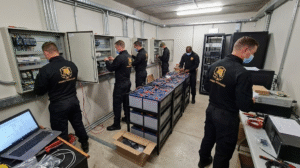
A screaming alarm keypad at 2 AM means your backup battery is failing. An alarm system that goes completely dead the second load shedding hits means the battery is already fried. A dead backup battery leaves your property entirely vulnerable to break-ins during power outages.
JK Armed Response operates the fastest local technical team to supply, install, and test new alarm batteries directly at your premises. We replace depleted 12V 7Ah batteries in all major South African systems, including IDS, Paradox, DSC, and Texecom. Your home security cannot afford downtime, and our technicians carry both standard and advanced lithium replacements in their vehicles.
Here is exactly what you need to know about your alarm battery right now:
- Standard have a maximum of roughly 300 to 500 charge cycles.
- Stage 4 load shedding consumes these cycles rapidly, often killing standard batteries in under 12 months.
- Upgrading to a Lithium Iron Phosphate (LiFePO4) battery increases your cycle count to over 2000.
- Opening your own alarm panel to swap the battery will immediately trigger a tamper signal to our control room.
These facts dictate how you should handle a failing security battery. You now have the core information needed to secure your property. The following sections will guide you through diagnosing your specific keypad faults, choosing the right battery chemistry, and understanding exactly why a professional installation protects your hardware.
4 Signs Your Alarm Battery Needs Immediate Replacement
Constant Keypad Beeping & “Trouble” Lights
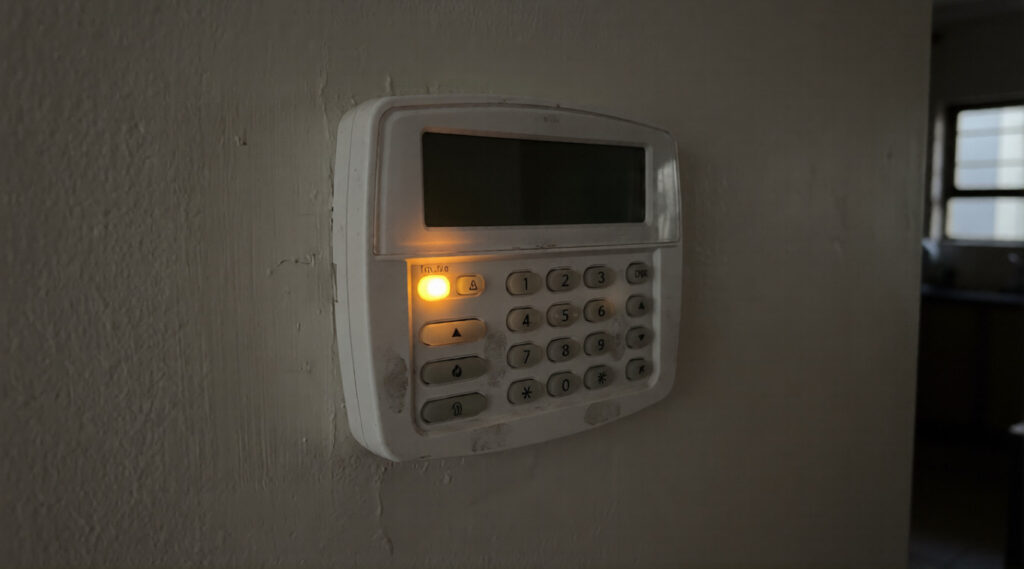
Modern alarm panels are programmed to alert you before the battery dies completely. If your IDS or Paradox keypad is emitting a continuous beep, check the display. You will typically see a yellow “Trouble” or “TRBL” light illuminated. Pressing the corresponding trouble key usually reveals a low battery fault code.
System Dies Instantly During Load Shedding
Your backup battery is the only thing keeping your passives and beams online when Eskom cuts the power. If your alarm system drops offline the exact moment load shedding begins, the battery cells have collapsed. The battery is no longer holding a charge and requires immediate replacement.
Random False Alarms
Voltage drops cause sensitive outdoor beams and indoor passive infrared (PIR) sensors to act erratically. When a degrading battery struggles to output a stable 12 volts, these sensors misinterpret the voltage fluctuation as movement. This triggers false alarms and dispatches a JK Armed Response vehicle to your home unnecessarily.
It’s Older Than 18–24 Months
A 12V 7Ah SLA battery installed before the current cycle of intense load shedding is likely at the end of its lifespan. Standard gel batteries perform optimally at around 20°C and lose capacity if repeatedly drained below 50%. If your battery is approaching the two-year mark, it cannot physically sustain an 8-hour power outage.
DIY vs. Professional Replacement: Why Call a Technician?
Opening a metal alarm box without notifying your security provider is a major security risk. The metal casing houses a spring-loaded tamper switch designed to detect unauthorized access. Breaking this seal triggers an immediate priority alarm, dispatching our armed reaction officers to your door.
Replacing the physical block is only half the job. Swapping out a depleted battery often requires clearing the “low battery fault” memory on the keypad. Our technicians know the specific installer codes required to reset these faults smoothly across different panel brands.
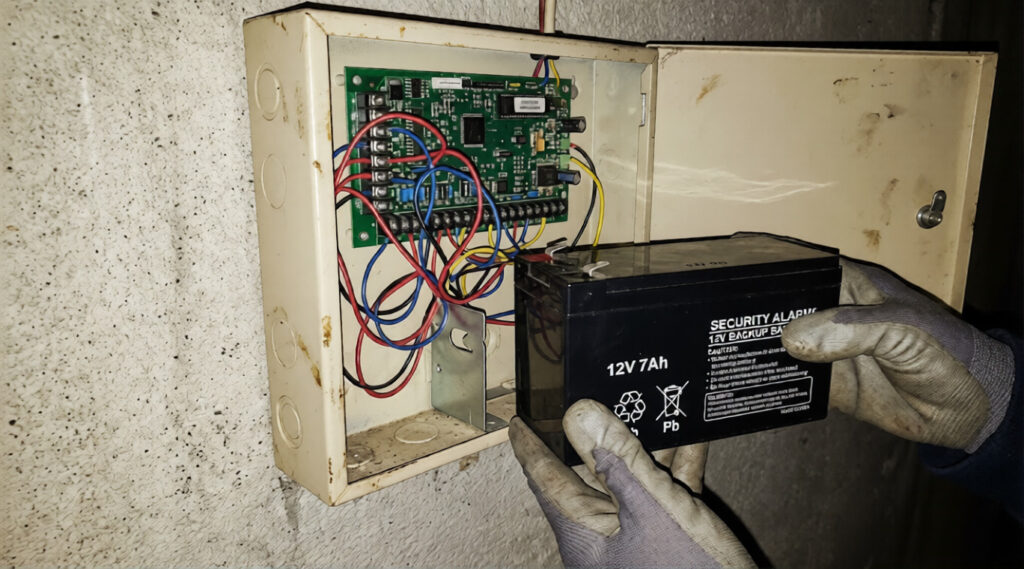
There is also a significant risk of sizing and terminal errors. Standard systems use a 12V 7Ah battery, but larger setups might require an 18Ah box. Pulling the old battery out incorrectly can easily snap the fragile terminal wires. Our technicians ensure the exact voltage, size, and terminal connections are matched perfectly.
Which Battery is Best for Your Alarm? (SLA vs. Lithium)
Standard 12V 7AH Lead-Acid/Gel
Sealed Lead Acid (SLA) batteries are the budget-friendly, traditional choice for home security. They are excellent for occasional backup power. However, their internal chemistry degrades quickly if they are drained completely multiple times a week. An SLA battery that is fully discharged during a long power cut may never recharge back to 100% capacity.
12V 7AH / 12.8V Lithium (LiFePO4)
Lithium Iron Phosphate is the ultimate South African upgrade for load shedding. A LiFePO4 battery costs more upfront but handles deep discharges flawlessly. It charges up to five times faster between load shedding slots. Most importantly, it features an internal Battery Management System (BMS) and lasts up to five times longer than an SLA equivalent. JK Armed Response technicians supply and install these premium lithium units upon request.
How Our “Near Me” Battery Replacement Service Works
- Log a Call: Contact the JK Armed Response control room directly or log a technical fault through our online portal.
- Dispatch: We dispatch a qualified local technician carrying the correct 12V replacement battery for your specific alarm system.
- Installation & Testing: We safely bypass the tamper switch, replace the old unit, reset your keypad faults, and conduct a full radio communication test. This ensures our control room receives your emergency signals clearly.
- Eco-Friendly Disposal: We remove the old, toxic lead-acid battery from your property and transport it to a certified recycling facility.
Frequently Asked Questions (Problem-Solving FAQs)
How do I stop my alarm keypad from beeping right now? You can often silence a beeping keypad temporarily by pressing the “Clear” or “#” button, depending on your panel brand. Acknowledge the trouble code by pressing the designated trouble key. This mutes the sound so you can sleep, but the system remains vulnerable until the battery is replaced.
How much does an alarm battery replacement cost? The total cost consists of two straightforward parts: our standard Technical Call-Out Fee plus the retail cost of the battery. SLA batteries are highly affordable, while Lithium variants carry a higher initial price tag but offer a much longer lifespan.
How long should a new battery last during a power outage? A fresh 12V 7Ah battery typically powers a standard home alarm system for 8 to 12 hours. This timeframe decreases if you run numerous high-draw devices off the panel, such as multiple outdoor passives, heavy-duty beams, or connected gate modules.
Book Your Alarm Battery Replacement Today
Stop tolerating the constant keypad beeping and secure your property against power-outage vulnerabilities. A dead battery means a dead alarm, and criminals know exactly when the grid goes down.
Contact JK Armed Response today to book your technical call-out. Visit our website at jkarmedresponse.co.za to log a fault, or call our control room directly. We service local neighborhoods rapidly, ensuring your home remains protected no matter what the power grid does.
Expert Alarm Battery Replacement Near Me (Fast & Hassle-Free)
A screaming alarm keypad at 2 AM means your backup battery is failing. An alarm system that goes completely dead the second load shedding hits means the battery is already fried. A dead backup battery leaves your property entirely vulnerable to break-ins during power outages. JK Armed Response operates the fastest local technical team to […]

One thought on “Expert Alarm Battery Replacement Near Me (Fast & Hassle-Free)”