
Recent POST



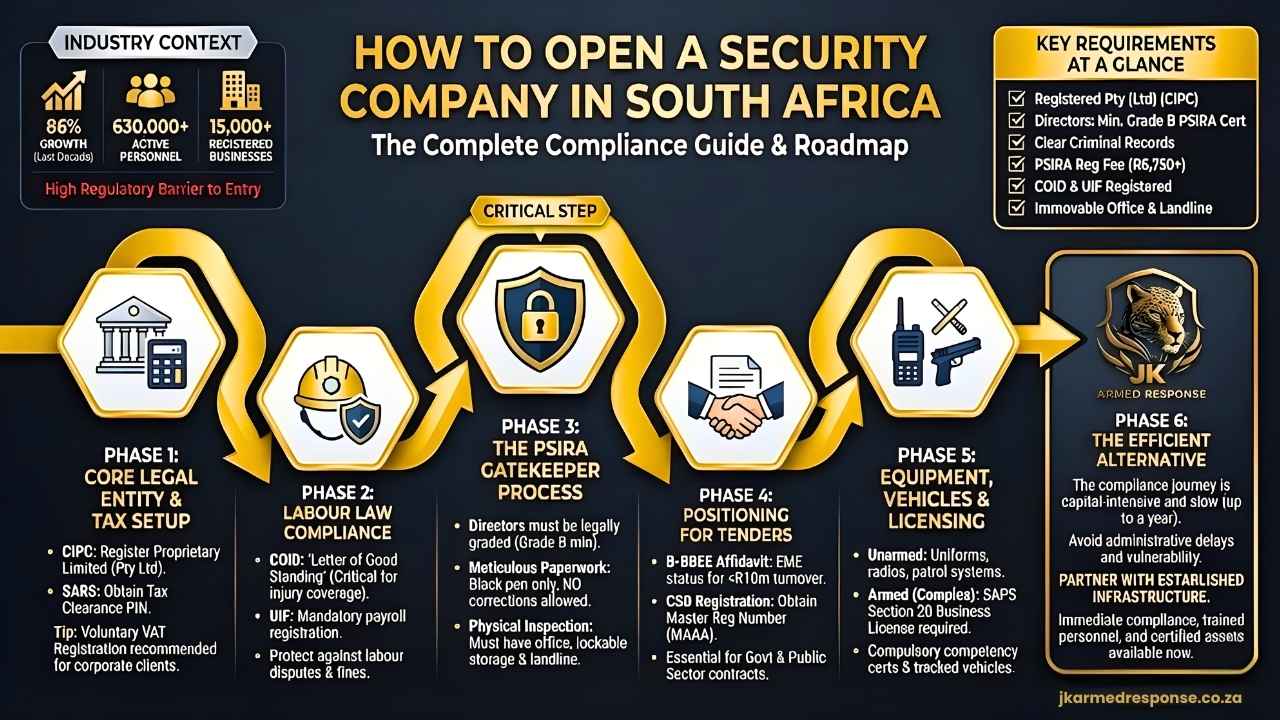
Starting a security company in South Africa requires strict adherence to legal and regulatory frameworks. Over the past decade, the Private security industry in South Africa has grown by 86%. According to recent statistics, the sector employs over 630,000 active security personnel and encompasses more than 15,000 registered businesses. The barrier to entry, however, is heavily regulated.
When I established my own security company, JK Armed Response (jkarmedresponse.co.za), navigating this regulatory red tape was the most challenging aspect. To save you time and capital, I will walk you through the exact steps to get compliant.
Key Requirements at a Glance:
- A registered Pty (Ltd) company via CIPC.
- Minimum Grade B PSIRA certification for all directors.
- Clear criminal records for all executive members.
- Non-refundable PSIRA business registration fee (currently R6,750).
- COID and UIF registration for labor compliance.
- An immovable office with a landline and a 1-year business plan.
Understanding the corporate legal foundation is your very first step in this process.
Phase 1: Core Legal Entity & Tax Setup (CIPC & SARS)
To secure corporate contracts, you must establish a recognized legal entity. Sole proprietorships are generally not accepted for major private or government tenders. You need to register a Proprietary Limited (Pty Ltd) company through the Companies and Intellectual Property Commission (CIPC).
Tax compliance is equally non-negotiable in this industry. You must obtain a Tax Clearance PIN from the South African Revenue Service (SARS). This proves to regulators and future clients that your business is in good standing.
Tax professionals highly recommend voluntary VAT registration even before you hit the R1 million mandatory turnover threshold. Large corporate clients strongly prefer dealing with VAT-registered vendors for their own tax benefits.
Getting your corporate structure right prevents immediate rejection from regulatory bodies. Once you legally form your company, you must secure your workforce’s safety net.
Phase 2: Labour Law Compliance (COID & UIF)
You cannot legally deploy a single security guard without strict Department of Labour compliance. The most critical document here is your Letter of Good Standing. This is issued by the Compensation for Occupational Injuries and Diseases (COID) fund.
Security work carries inherent physical risks on a daily basis. COID registration ensures your staff are financially covered in the event of on-duty injuries. Operating without it exposes your business to severe liability.
Alongside COID, you must register your business for the Unemployment Insurance Fund (UIF). Standard payroll compliance protects your business from heavy fines and labor disputes down the line.
Many startup security firms fail early because they attempt to cut corners on fundamental labor laws. With your CIPC, SARS, and labor registrations complete, you are ready to face the ultimate industry gatekeeper.
Phase 3: The PSIRA Registration Process (The Industry Gatekeeper)
The Private Security Industry Regulatory Authority (PSIRA) dictates who can legally operate in South Africa. This is where the bulk of new applications are delayed or rejected. The most vital rule is that every director, manager, or partner must personally hold a minimum Grade B PSIRA certification.
You cannot register a security business if the leadership is not individually graded and cleared. The business application requires meticulous attention to administrative detail. You must submit a comprehensive one-year business plan proving your operational viability.
The paperwork itself is notoriously strict. For example, the applicant must complete the suretyship form (SIRA-4) in black pen only. All directors and two witnesses must initial every single page. A single scratch-out or use of correction fluid will result in an immediate provisional rejection.
PSIRA will also conduct a physical infrastructure inspection of your premises. You must have an immovable office with a lockable storage facility and a registered landline in the business’s name.
Passing the PSIRA inspection and criminal checks allows you to legally operate. The next phase involves positioning your compliant business to actually win lucrative contracts.
Phase 4: Positioning for Tenders (B-BBEE & CSD)
Government and public sector contracts are highly profitable avenues for a new security company. To access these, you need specific certifications beyond basic security compliance. First, secure a Broad-Based Black Economic Empowerment (B-BBEE) affidavit.
Startups earning under R10 million annually qualify as Exempted Micro Enterprises (EME). This affidavit gives you the necessary procurement points to compete. Next, you must register your company on the Central Supplier Database (CSD).
This generates a Master Registration Number (MAAA). No government department or local municipality can procure your services without this MAAA number.
These certifications make your business visible to state procurement officers. However, visibility means nothing unless you properly equip your personnel for the realities of the job.
Phase 5: Equipment, Vehicles, and Firearm Licensing
Deciding between armed and unarmed guarding dictates your equipment overhead. Unarmed guarding requires standard uniforms, radios, and basic patrol monitoring systems. Armed response is a completely different logistical and legal challenge.
If you plan to arm your response units, you must navigate the Firearms Control Act. You must secure a Section 20 business firearm license through the South African Police Service (SAPS). This is completely separate from standard PSIRA guarding regulations.
Your personnel must also hold specific competency certificates for business purposes. The vehicles used for armed response must be registered to the business entity and fitted with compliant tracking systems.
Building this infrastructure is capital-intensive and time-consuming. When building my own agency, I realized exactly how demanding this specific logistical phase can be for new entrants.
Phase 6: The JK Armed Response Journey
Building a fully compliant, PSIRA-registered armed response unit takes immense capital, strict grading, and months of administrative waiting. The journey of building JK Armed Response was rooted in solving these exact industry bottlenecks.
We saw that local communities in South Africa needed rapid deployment and reliable protection. However, the regulatory red tape meant new security providers often took up to a year to become operational.
We focused heavily on the foundation. By ensuring all our directors held the correct Grade B certifications from day one, and passing our infrastructure audits on the first attempt, we established a highly compliant agency. Through our platform, jkarmedresponse.co.za, we now offer that hard-earned compliance directly to our clients.
For businesses, estates, or individuals who need immediate protection, starting a company from scratch is rarely the most efficient solution. The administrative delays can leave your assets and personnel vulnerable for months. Partnering with an established, fully compliant firm eliminates that risk entirely.
At JK Armed Response, we already hold the necessary certifications, trained personnel, and physical infrastructure.
Would you like me to analyze your current security requirements to see how our established infrastructure at JK Armed Response can assist you immediately?
How to Open a Security Company: 2026 SA Guide
Starting a security company in South Africa requires strict adherence to legal and regulatory frameworks. Over the past decade, the Private security industry in South Africa has grown by 86%. According to recent statistics, the sector employs over 630,000 active security personnel and encompasses more than 15,000 registered businesses. The barrier to entry, however, is […]

One thought on “How to Open a Security Company: 2026 SA Guide”